

Cardiac arrhythmia (irregular heartbeat)
Changes of the heart muscle (cardiac muscle) – subject to congenital additional structures or long lasting blood pressure – facilitate cardiac arrhythmia (irregular heartbeat).
Symptoms cardiac arrhythmia (irregular heartbeat)
If you suffer from cardiac arrhythmia, different symptoms can occur like rapid heartbeat (tachycardia), shortness of breath (dyspnea), stop of the heartbeat, palpitations and/or a decrease of your physical fitness (especially given atrial fibrillation).
Symptoms of cardiac arrhythmia at a glance
- rapid heartbeat
- shortness of breath (dyspnea)
- stop of heartbeat
- palpitations
- decrease of your physical fitness (especially in case of atrial fibrillation)
Causes of cardiac arrhythmia (irregular heartbeat)
Cardiac arrhythmia can be caused or facilitated by congenital additional structures of the heart, long lasting blood pressure, coronary artery disease (CAD) as well as heart failure.
Causes of cardiac arrhythmia at a glance
- congenital, additional structures of the heart
- long lasting blood pressure
- coronary artery disease (CAD)
- heart failure
Diagnostics cardiac arrhythmia (irregular heartbeat)
The simplest instrument in the diagnostics of cardiac arrhythmia (irregular heartbeat) is the ECG (electrocardiography) while you are resting. If it is not possible to document palpitations of the heart this way, a 24-hour ECG is the next diagnostic step.
In case the 24-hour ECG does not provide any information about cardiac arrhythmia, it is possible to examine your heart very thoroughly over a period of several months by implanting miniature sensors. Such a miniature sensor weighs only 2.5 g (0.07 oz.), has a volume of 1.2 ccm (0.04 fl. oz.) and is implanted under your skin above the heart under local anesthesia. Patients who underwent this surgery, did not feel its presence afterwards. The data collected by the sensor can be transmitted to our department via a modern telemedicine transmission (MyCareLinkTM) no matter if you are at home or on the road. We can then react quickly and initiate further steps in case of any signs of cardiac arrhythmia.
Treatment cardiac arrhythmia (irregular heartbeat)
If you are suffering from a special form of cardiac arrhythmia, the supraventricular tachycardia, e. g., atrioventricular (AV) nodes, re-entry tachycardia or focal atrial tachycardia, pharmacotherapy (use of medication) is secondary. The best therapy option is the so-called catheter ablation.
Catheter ablation can also help curing atrial flutter.
In case of palpitations caused by premature ventricular contractions (PVC, additional heartbeats originating from ventricles), catheter ablation is also the best treatment option.
In rare cases, e. g., additional heartbeats originating from an anatomically unfavorable position, the treatment with specific heart medication is indicated.
Since the treatment of atrial fibrillation is quite complex, comprehensive consultation is necessary to decide on either pharmacotherapy or catheter ablation.

Coronary artery disease (CAD)
The coronary artery disease (CAD) is a circulatory disorder of the heart muscle. Long lasting inflammation of vascular walls lead to an increasing narrowing, and thus, decrease of blood flow. As a result, the heart/heart muscle lacks of nutrients and oxygen – firstly only during physical stress, secondly even when resting. If it is not diagnosed and treated early enough, it can cause an acute myocardial infarction/heart attack.
Symptoms coronary artery disease (CAD)
Symptoms of the coronary artery disease (CAD) comprise an increasing feeling of exhaustion and decreased physical fitness. Additionally, chest tightness, short breath during physical stress, palpitations, shoulder pain and radiating shoulder pain into the arms as well as sleep disorders/snoring can occur.
Symptoms of coronary artery disease (CAD) at a glance
- increasing feeling of exhaustion
- decreased physical fitness
- chest tightness
- short breath during physical stress
- palpitations
- shoulder pain and radiating shoulder pain into the arms
- sleep disorders/snoring
Causes coronary artery disease (CAD)
Causes of coronary artery disease (CAD) include smoking, high blood pressure, high blood cholesterol levels, diabetes mellitus, heart diseases within family history and insufficient physical exercise/overweight.
Causes of coronary artery disease (CAD) at a glance
- smoking
- high blood pressure
- high blood cholesterol levels
- diabetes mellitus
- heart diseases within family history
- insufficient physical exercise/overweight
Diagnostics coronary artery disease (CAD)
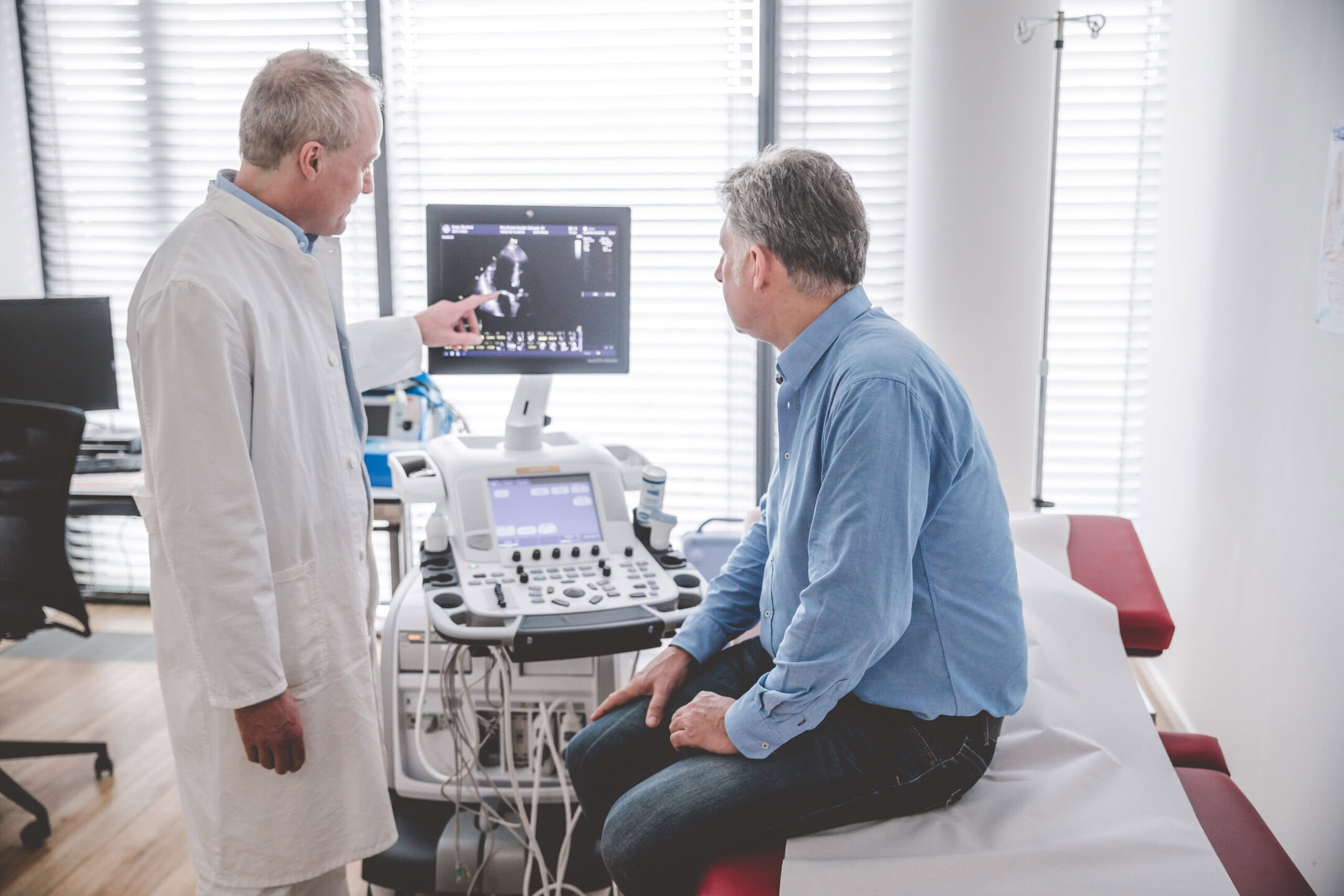
The basic means of diagnosing coronary artery disease (CAD) include the ECG examination as well as echocardiography (ultrasound examination of the heart) – both while resting. If both examinations do not yield sufficient information about pathological changes of the heart, a cardiac stress test (ultrasound examination of the heart under either physical or drug induced stress) or a cardiac stress MRI (MRI examination under drug induced stress) are good options to diagnose or rule out coronary artery disease.
The best option that delivers immediate precise information of possible changes of coronary arteries is coronary catheterization. During this examination, a catheter is inserted through the artery of your wrist and carefully guided to the coronary arteries in order to examine them thoroughly.
Treatment coronary artery disease (CAD)
The treatment of coronary artery disease (CAD) consists of two parts: medication and cardiac intervention. During coronary intervention, a catheter is inserted through the artery of your wrist and carefully guided to the coronary arteries in order to treat the stenosis (narrowing) of the arteries by dilatation (widening) as well as stent placement or bioresorbable vascular scaffolds.

