
Epilepsy

Make an appointment with our neurosurgeons at the Beta Klinik in Bonn.

Contact and consultation hours

Beta International Epilepsy Centre

Email: christian.elger@betaklinik.de

Phone: +49 (0)228 90 90 75 750

Fax: +49 (0)228 90 90 75 752

Consultation hours

Monday till Thursday from 8 a.m. – 5 p.m.

Friday from 8 a.m. – 1 p.m.

by arrangement

Correct diagnosis and sustainable treatment of epilepsy and seizure-related disorders

Epilepsy is a complex disorder with many various causes, and it is one of the most common neurological diseases. The main symptoms are epileptic seizures, whose phenomena can be very different and which – depending on their severity – can have decisive influence on the everyday lives of patients. Severe epileptic seizures can, in worst-case scenarios, be fatal or heavily burden people with health and social difficulty. Even minor seizures can significantly restrict patients at school, at work and in their private lives.

Epilepsy is not a single disease. Rather, it comprises a large number of central nervous disorders and diseases, all of which have epileptic seizures as leading symptoms. Genetic disposition also plays a significant role. Whether people with epilepsy have their first seizures earlier or later in their lives depends on their predisposition. Once genetic causes have been clarified, forms of therapy can be devised in more targeted manners, and patients wishing to have children can be better advised. In addition to epileptic seizures, seizure-related disorders in which epilepsy is not the cause also exist. These include certain disorders of the motor system, syncope and mental illness. Differentiation is often associated with great diagnostic difficulty.

Epilepsy is a complex disorder with many various causes, and it is one of the most common neurological diseases. The main symptoms are epileptic seizures, whose phenomena can be very different and which – depending on their severity – can have decisive influence on the everyday lives of patients. Severe epileptic seizures can, in worst-case scenarios, be fatal or heavily burden people with health and social difficulty. Even minor seizures can significantly restrict patients at school, at work and in their private lives.

Epilepsy is not a single disease. Rather, it comprises a large number of central nervous disorders and diseases, all of which have epileptic seizures as leading symptoms. Genetic disposition also plays a significant role. Whether people with epilepsy have their first seizures earlier or later in their lives depends on their predisposition. Once genetic causes have been clarified, forms of therapy can be devised in more targeted manners, and patients wishing to have children can be better advised. In addition to epileptic seizures, seizure-related disorders in which epilepsy is not the cause also exist. These include certain disorders of the motor system, syncope and mental illness. Differentiation is often associated with great diagnostic difficulty.

In Germany alone, more than 600,000 people live with epilepsy – and every year, approximately 40,000 new people, from all age groups, are affected by it. About 200,000 of them are considered difficult to treat. As anti-epileptic drugs do not render these patients seizure-free, special diagnostics and therapies are required.

The Beta International Epilepsy Centre (Beta IEC) investigates the causes of this chronic central nervous system disease, examines differential diagnoses and develops individual forms of therapy for patients of all ages.

Prof. Dr. med. Christian E. Elger is the head of the Beta IEC. The seasoned epilepsy specialist is internationally esteemed and has many years of experience in the research and treatment of epilepsy. He was the director of a renowned hospital and research institution for many years. In 2018, together with Prof. Dr. med. Thomas Gasser and Dr. med. Axel Jung, he founded the Beta IEC and took over its medical leadership – after more than 25 years as the Director of the Clinic and Polyclinic for Epileptology at the University of Bonn. Via interdisciplinary exchanges with the neurology, clinical neurophysiology and neurosurgery departments, the Beta IEC enhances the Bonner Bogen medical facility.

For the diagnosis of epilepsy, Beta IEC specialists use the Beta Klinik’s modern equipment, such as magnetic resonance imaging (3 Tesla MRI scanner), to examine the brain. Resultingly, changes in the cerebral cortex can be recognized as possible causes of epilepsy.

In addition, certain parameters have to be clarified, such as

  • descriptions of seizures
  • differential diagnosis of seizure disorders
  • epilepsy history
  • medication history
  • level of anti-epileptic drugs
  • neuropsychological diagnostics
  • causes of epilepsy, including genetics and autoimmune diseases
  • short and long-term electroencephalography, including video recording (also via implanted electrodes)

 Therapeutic range of services

  • drug treatment
  • ketogenic diet
  • epilepsy surgery with MR laser ablation
  • resective epilepsy surgery (in cooperation with the University of Bonn Neurosurgical Clinic)
  • stimulation therapy for epilepsy (vagus nerve stimulation)
  • treatment of autoimmune diseases and associated epilepsy
  • treatment of patients with tuberous sclerosis and associated epilepsy
  • treatment of patients with other neurological disorders, such as migraine

In close cooperation with the neurosurgery team, all diagnostic procedures involved in the preparation of epilepsy surgery – the implantation of stereotactic electrodes for the localization of epileptic foci – can be implemented. MRI-guided laser ablation makes these epilepsy surgery procedures particularly gentle.

As a result of close cooperation with the BetaGenese Klinik, which is also located on the Beta Klinik campus, patients, particularly those with psychogenic, non-epileptic seizures, who would rarely receive joint care elsewhere (psychosomatic medicine and epileptology), can receive excellent treatment.

Interdisciplinary communication and a lively, close exchange of medical knowledge among the various medical disciplines at the Beta Klinik make personalized examination and treatment of epilepsy, with its various facets, possible.

Neurozentrum EEG

Diagnose and treat epilepsy correctly

Epilepsy belongs to one of the well treatable neurological diseases. Up to two thirds of all patients with epilepsy can be medically treated, and most after the first or second attempt are completely free of seizures.

One third of patients are not free of seizures even after several attempts. Under certain circumstances, around 20 percent of these patients can undergo successful epilepsy surgery treatment. In the absence of epilepsy surgery treatment options or when the patient decides against such treatment, they have the option of the so called recent Vagus Nerve Stimulation.

Apart from the ketogenic diet, other treatment strategies such as natural medicine, acupuncture, homeopathy and psychotherapy are lacking studies in proven effectiveness.
Visualase Neuro-Zentrum

Pre-surgical epilepsy diagnostics

Functional diagnostics: Examinations to identify the area of the brain causing the seizures

  • Video/EEG-long term monitoring. Recording of brain waves from the scalp and video monitoring of the patient.
  • MRI (Magnetic Resonance Imaging). Procedures to demonstrate the brain structure and where applicable, changes to the brain structure.
  • SISCOM: complex procedures to demonstrate the beginning of an epileptic seizure with increasing focal metabolic activity.
  • Positron Emission Tomography (PET): a seldom used procedure to demonstrate the reduced metabolic activity in the centre of the seizure focus.
  • Electrocorticography: Recording of the brain waves directly from the brain tissue with implanted electrodes.

Examination of the adjoining functional brain area with:

  • Language-fMRI: functional magnetic resonance imaging to localize the language areas. Can sometimes be replaced by the Wada-Test.
  • Wada-Test, or intracarotoid sodium amobarbital procedure: anaesthetisation of one half of the brain (approx. 15 minutes) in order to examine the hemispheric localisation of language function.
  • Cortical electrostimulation: direct electric stimulation of the cortex to determine function around the seizure location.

With the help of standardised neuropsychological tests, the status quo of the cognitive performance is documented and checked again post-operatively. Important insights in respect to the decrease in brain function can be gained from the neuropsychological performance profile.

Netzwerk Epilepsie und Arbeit (NEA)

The “Network Epilepsie und Arbeit” is your contact partner for all social and employment law related questions which have to do with your epilepsy.

In-depth information as well as the right contact partners for your federal state can be found on the network’s website: www.epilepsie-arbeit.de.

The network is financed by the “Innere Mission München, Diakonie in München und Oberbayern e.V.” and supported by the Ministry of State for Employment and Social Affairs.

Special information on the topic of epilepsy and rehabilitation can be found on the website: www.epilepsie-rehabilitation.de.

Minimally invasive surgical procedure for treating epilepsy

MRI controlled laser ablation technology for epilepsy

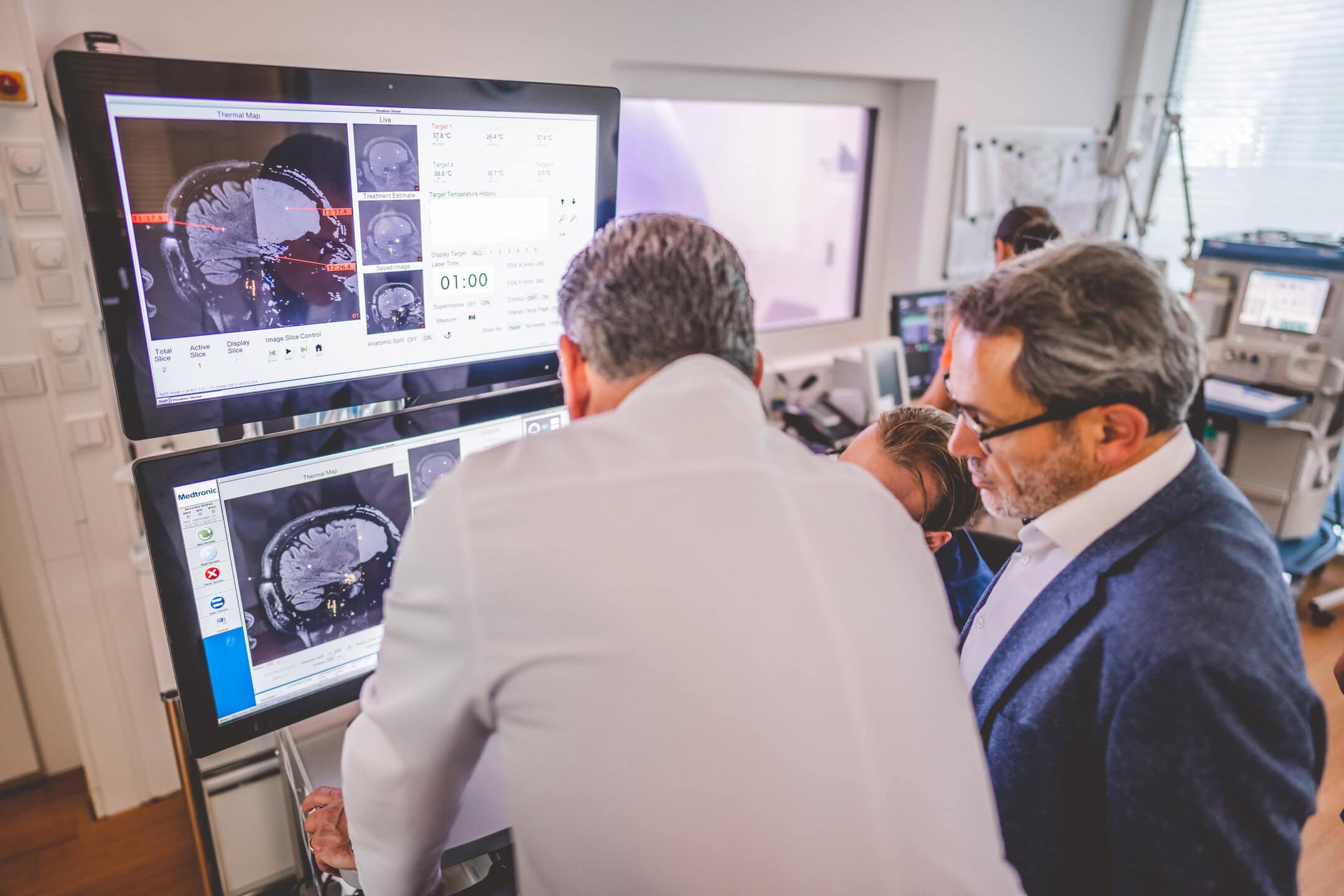
With VISUALASE™, The Beta Klinik is one of only three clinics in Europe to date offering this minimally invasive surgical procedure for the treatment of epilepsy.

With laser ablation technology, patients with epilepsy have the active tissue in the brain gently and precisely removed by laser. Most patients can be discharged on the same day after this treatment.

How does Visualase Technology work?

The area to be treated is thoroughly examined at The Beta Klinik using magnetic resonance imaging and is precisely defined. Following this, epilepsy specialist Prof. Dr. Christian Elger and the highly experienced neurosurgeon and operating surgeon Prof. Dr. med Thomas Gasser, define the target area for the laser ablation using stereotactic procedures. A millimetre-sized hole is drilled in the skull through which a laser catheter and applicator are inserted into the brain.

Laser energy is delivered to the target area using this applicator and causes an increase in temperature in the targeted area. The soft tissue is removed without damaging the surrounding area.

The effect of the laser treatment is closely monitored during the whole procedure by the experts using real time magnetic resonance imaging. Special safety precautions prevent the laser from being too hot and also protect the healthy areas in the brain from its energy.

Visualase Technology has already been successfully used for over ten years in the USA. In the middle of 2018, the Medtronic device obtained the CE label for the European Union and may now be used here.

This site is registered on wpml.org as a development site. Switch to a production site key to remove this banner.