


Decompression / microlaminectomy
Course microlaminectomy / decompression surgery
By the so-called decompression, the thickened and protruding bone and ligament formations are removed, and, thus, the nomal diameter of the spinal canal is reconstructed. Because decompression surgery is a minimally invasive operation even suitable for risk patients, it can be undergone in local anaesthesia. However, in most cases, a very gentle general anaesthesia is used.
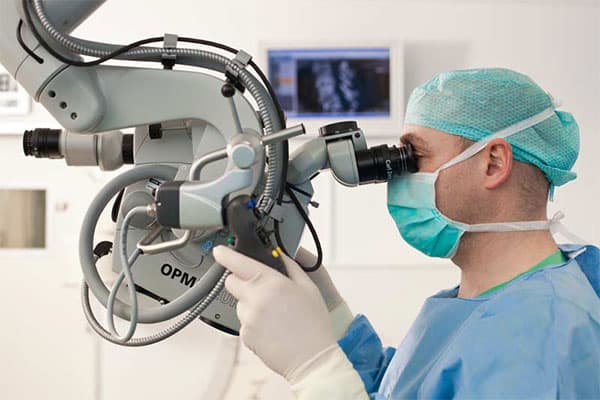
By use of of a microscope and microscopic fraises, similar to those dentists use, the protruding bone is removed millimeter for millimeter until the nerves have enough space. Depending on the extent of stenosis, it is practiced from one or both sides. Thereby, the stability of spine remains. A posterior cut of 3-5 cm length is necessary for one level. If there is an additional instability (listhesis), it is possible to stabilize the vertebrae with a synthetic ligament, which is well-tolerated and does not burden the body. In both cases, patients can stand up and walk 2 hours after surgery, and usually they can go home 2 days later.
Aftercare and Rehabilitation
One day after surgery, there is a follow-up examination including consultation. For an optimal result, patients should start with physiotherapy 2 weeks after the operation. They will get instructions about how to move without risking damage of the back and about what has to be done in physiotherapy. Physiotherapy can take place at the Beta Klinik or as an outpatient at hometown. If there are any further questions, patients should not hesitate to ask the physiotherapists of the Beta Klinik at any time. There is a neurological-orthopaedic follow-up 3 month after surgery.
Success Rate
There is an excellent or very good result in 85%. Recovery time amounts several weeks because nerves have been clamped for a long time due to spinal stenosis.

